



FPC Montgomery Minimum Security
The predawn knock had the authority and full backing of the United States Government. It is not a sound that anyone should ever have to hear. I expected to be tackled when I opened the door. But it was just two agents, one FBI and one DEA. They left me standing in the doorway with a federal indictment, but without telling me anything I needed to know. Like WTF happens next? I had no idea what to expect or what to do?
If I only knew then what I know now…
A federal indictment is the culmination of a months (years) long investigation. For you it marks the beginning of a multiple years long process.
Pretrial Services Investigation. A Federal Probation officer is assigned to the case and starts gathering background information on you. They use a ‘Pretrial Risk Assessment Tool’ that evaluates the likelihood of your showing up for court, and the risk of continued or new criminal activity. Everything they find is written up in a report for the arraignment hearing judge. . Federal Arraignment Hearing. At the end of the hearing, you’ll either be released or taken into custody. The decision the Judge makes is based on the pretrial services investigation report.
Pretrial Supervision (if released). Immediately after the arraignment hearing you’ll meet with a federal probation officer. There you’ll be informed of the requirements of Supervised Pretrial Release; Travel restrictions, Drug testing, Employment requirements, Physically reporting to the probation officer, Home visits by probation officer, Coordination with family, employers, and treatment providers.
Plea Agreement or Trial. 98% of people sign a plea deal and either remain on pretrial supervision until the sentencing hearing, or will be taken into federal custody. 2% of people bat it up and go to trial. Of those 2%, 10% beat their case. 90% are found guilty by a jury of their peers and scheduled for sentencing hearing.
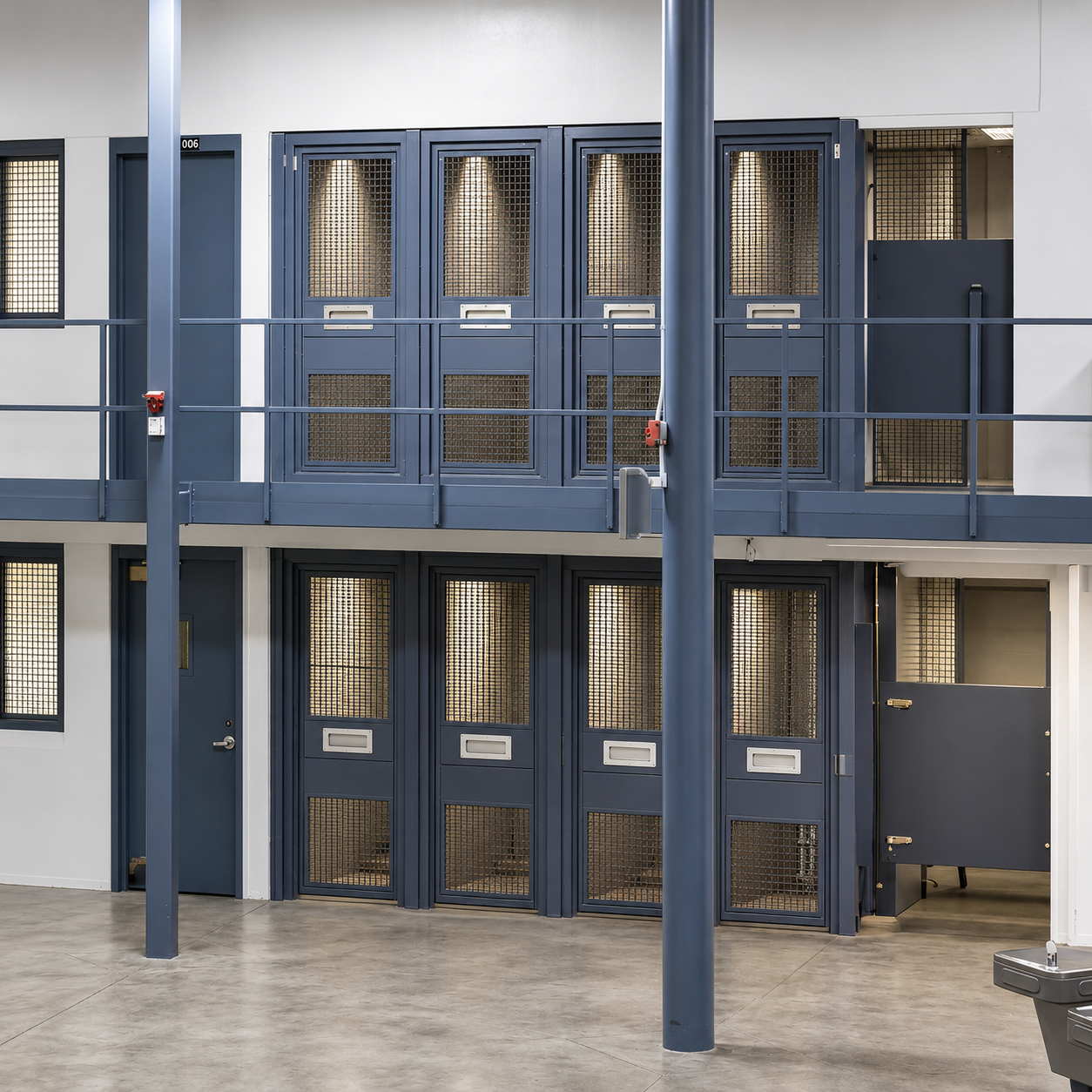
USP Terre Haute Housing Unit Shower Cages
PSI and PSR are often used interchangeably, but they technically refer to two different parts of the same process.
PSI (Presentence Investigation/Interview): This is the process. It refers to the actual investigation conducted by the U.S. Probation Officer, which includes interviewing the individual, verifying their background, and researching the offense.
PSR (Presentence Report): This is the document. It is the final written report that summarizes the findings of the investigation and is provided to the judge, the defense, and the prosecution.
What is the Pre-Sentencing Report? (PSR)
Judges use the PSR to calculate the advisory Federal Sentencing Guidelines and determine if a "downward departure" (a shorter sentence) is warranted.
The Bureau of Prisons (BOP) uses the PSR to decide where you serve your time (security level and facility designation).
Program Eligibility: determines if you qualify for RDAP, which can reduce a sentence by up to a year
Release Planning: It follows you through your entire term and is used by probation officers to manage your eventual supervised release.
If you plead guilty or are found guilty at trial, you will be sentenced in a separate and subsequent hearing. After a guilty plea at arraignment or a guilty verdict at a trial, the judge will order the probation office to prepare a Pre-Sentence Report. The probation officer will conduct a Pre-Sentence interview with you before he or she prepares the Pre-Sentence Report.
The Pre-Sentencing Interview is conducted by qualified federal probation officers. They have college degrees in criminal justice, psychology, sociology, and law; have strong investigative, analytical, and writing skills, and have completed specific training for the pre-sentencing investigation. Federal probation officers are not affiliated with the defense nor the prosecution. They are impartial, independent, and believe in the presumption of innocence.

The Pre-Sentencing Report (PSR) is organized into distinct parts:
Part A: The Offense
Offense Conduct: A detailed narrative of the crime, including the defendant’s specific role, any co-defendants, and the impact on victims.
Victim Impact: Verified information regarding the financial, social, psychological, and medical impact on any victims.
Adjustment for Acceptance of Responsibility: An assessment of whether the defendant has clearly demonstrated recognition and affirmative acceptance of personal responsibility for their criminal conduct.
Guideline Calculations: Calculation of the Base Offense Level and any specific offense characteristics (e.g., use of a special weapon, amount of loss) that increase or decrease the score.
Part B: Criminal History
Prior Convictions: A chronological list of all adult and juvenile arrests and convictions.
Criminal History Points: Assignment of points for past sentences (e.g., 3 points for a sentence over 13 months) to reach a final category from I to VI.
Other Criminal Conduct: Information on pending charges or prior arrests that did not lead to convictions but may be relevant.
Part C: Offender Characteristics
Personal and Family Data: Questions about parents, siblings, marital status, children, and the current living environment.
Physical Condition: A review of current health, chronic conditions, and past medical history.
Mental and Emotional Health: Information on any diagnosed psychiatric conditions, prior hospitalizations, or current therapy.
Substance Abuse: Detailed history of drug or alcohol use, including first use, frequency, and any previous treatment programs.
Education and Vocational Skills: Records of highest grade completed, degrees earned, and specialized training.
Employment Record: A 10-year work history including job titles, dates of employment, and reasons for leaving.
Financial Condition: A full accounting of assets, monthly income, debts, and the ability to pay fines or restitution.


Part D is titled Sentencing Options. This section translates the data from previous parts into specific legal and guideline-based punishment ranges. The primary purpose of this section is to provide the judge with a side-by-side comparison of what the statutes (laws passed by Congress) allow versus what the U.S. Sentencing Guidelines recommend.
Statutory Provisions: Lists the minimum and maximum penalties (prison time, fines, etc.) required by the specific law the defendant violated.
Guideline Provisions: Sets forth the advisory sentencing range (e.g., 51–63 months) calculated by the probation officer based on the defendant's offense level and criminal history.
Custody Options: Details whether the defendant is eligible for probation, home detention, or commonfinement (like a halfway house).unity c
Supervised Release: Outlines the required or recommended period of federal supervision that follows a prison term.
Financial Penalties: Specifies the statutory and guideline ranges for fines, restitution owed to victims, and any applicable forfeitures.
Impact of the Plea Agreement: If a plea deal exists, the probation officer analyzes how it affects the potential sentence compared to if the defendant had gone to trial or pleaded to all counts.
Part E of the PSR, titled Departures and Variances, is where the probation officer identifies reasons why the calculated guideline range might be too harsh or too lenient.
1. Downward Departures (Lower Sentence)
The officer or your attorney can argue that the Criminal History Category (from Part B) "over-represents" your past. Common reasons include:
Minor Old Convictions: Having several very old, minor points that pushed you into a higher category than someone with a truly violent past.
Substantial Assistance: Under Section 5K1.1, if you provided significant help to the government in other investigations.
Exceptional Family Ties: If your incarceration would cause an extraordinary hardship on dependents that goes far beyond the "normal" hardship of prison.
Early Disposition: Taking part in "fast-track" programs in certain judicial districts.
2. Upward Departures (Higher Sentence)
Conversely, if the officer feels the math "under-represents" the danger you pose, they may suggest a higher sentence. This happens if:
Pending Charges: You have a long list of serious charges awaiting trial that weren't counted in the points.
Similar Misconduct: You have a history of committing the exact same crime repeatedly, showing the prior sentences didn't deter you.
Extreme Conduct: The crime involved unusual cruelty, multiple weapons, or a level of planning not fully captured by the "points" in Part A.
3. The Difference Between a Departure and a Variance
Departure: A change based on specific rules found within the U.S. Sentencing Guidelines manual.
Variance: A change based on the "3553(a) Factors". These are broader legal principles, like your personal character, your "difficult upbringing," or the need for the sentence to reflect the "seriousness of the offense."

What Happens Next? Once Part E is completed, the draft PSR is sent to your lawyer and the prosecutor. You then have 14 days to file "Objections" if you disagree with any of the facts or the math used in Parts A through E.
The objection process is the formal mechanism for challenging inaccuracies in a Pre-Sentence Report (PSR) report. Under Federal Rule of Criminal Procedure 32(f), this process follows a strict timeline and sequence to ensure the judge has a reliable document at sentencing. The BOP relies almost entirely on the narrative and data provided by the probation officer in the PSI. If the PSI inaccurately describes an offense as "violent" or fails to note that a detainer has been cleared, it can result in an inappropriately high security score. If objections are not raised within 14 days, they are generally considered waived and cannot be brought up later on appeal unless there is "good cause" for the delay.
In a Pre-Sentence Report (PSR) , Part A is essentially a mathematical calculation known as "score-keeping" to reach a Total Offense Level. This score ranges from 1 (least serious) to 43 (most serious) and is calculated using the following steps:
1. Identifying the Base Offense Level:
The probation officer starts by looking at the specific statute you were convicted of and finding the corresponding guideline in Chapter Two of the U.S. Sentencing Guidelines Manual. Every crime has a fixed "Base Level" (e.g., first-degree murder is Level 43, while residential burglary starts at Level 17).
2. Adding Specific Offense Characteristics:
Next, the officer adds or subtracts points based on the unique details of the crime. These are often the most contested facts in a case. Common factors include: Loss Amount: In fraud or theft cases, the level increases as the dollar amount of the loss increases. Weapon Use: Points are added if a firearm was brandished or used during the offense. Victim Harm: Points are added if a victim sustained bodily injury or if they were particularly vulnerable.
3. Applying Chapter Three Adjustments:
These are general adjustments that can apply to almost any type of crime. Victim-Related: Increases for "hate crimes" or if the victim was a government official. Role in the Offense: Increases if you were a leader or organizer (2–4 levels) or decreases if you played a minimal or minor role. Obstruction of Justice: A 2-level increase if you attempted to impede the investigation or lied to authorities.
4. Multiple Count Grouping:
If you were convicted of multiple crimes, the officer applies "grouping rules" to ensure you aren't unfairly punished for the same conduct multiple times, while still accounting for the total harm caused.
5. Acceptance of Responsibility:
This is the final step in Part A. If you plead guilty and demonstrate genuine remorse, you are usually eligible for a 2 to 3 level reduction in your score.
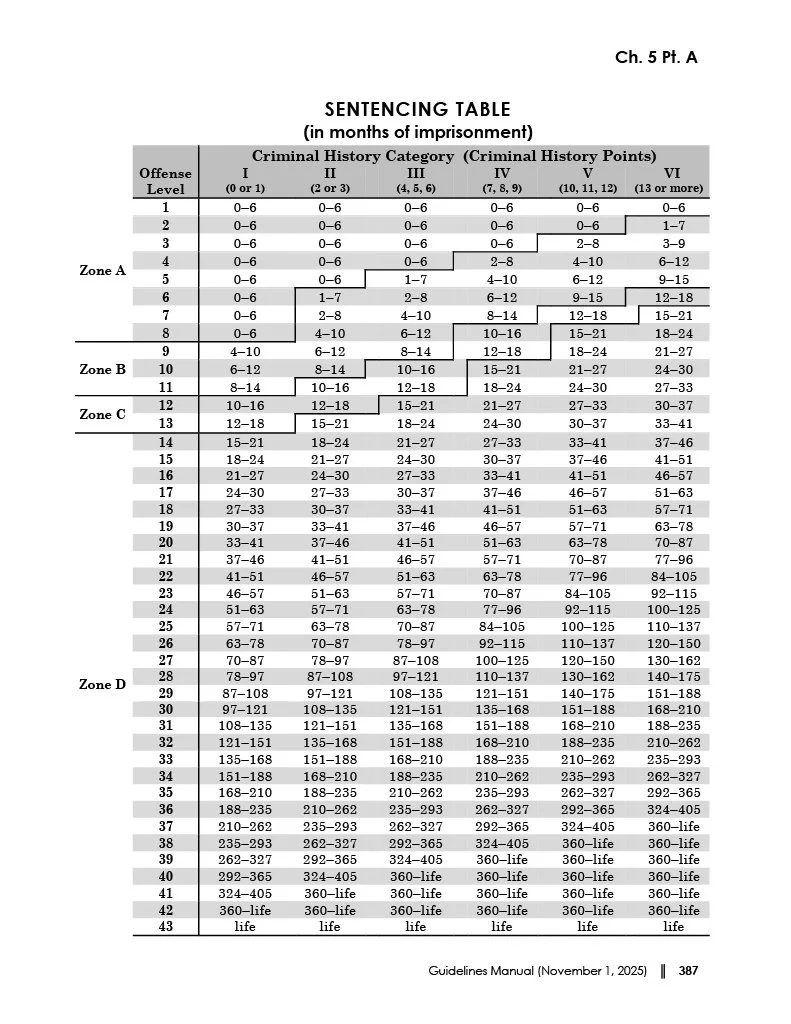
The final number reached after all additions and subtractions is your Total Offense Level. In Part D of the report, this number is cross-referenced with your Criminal History Category (from Part B) on a Sentencing Table to find your recommended range in months.
In a federal Pre-Sentence Report (PSR), Part B calculates your Criminal History Category by assigning points to your past record. This total determines your position on the horizontal axis of the Sentencing Table.
The Point System. Points are assigned based on the length of the sentence imposed for prior offenses, regardless of whether they were felonies or misdemeanors:
3 Points: Each prior sentence of imprisonment exceeding one year and one month (13 months).
2 Points: Each prior sentence of imprisonment of at least 60 days but not more than 13 months.
1 Point: Each prior sentence of less than 60 days (this includes fines-only, probation, or suspended sentences). You can receive a maximum of 4 points in this sub-category.
Status Points. You may receive "Status Points" if you committed the current federal offense while under any "criminal justice sentence".
+2 Points: If you were on probation, parole, supervised release,, imprisonment, or escape status at the time of the new crime. Juvenile Adjudications
Juvenile Adjudications.
3 Points: If you were convicted as an adult for a crime committed before age 18 and received over 13 months.
2 Points: For juvenile confinement of at least 60 days, if you were released within 5 years of starting the current federal offense.
Exclusions and "Staleness". Not every past arrest counts toward your score:
Staleness: Sentences over 13 months generally don't count if they were imposed more than 15 years ago. Shorter sentences usually have a 10-year limit.
Minor Offenses: Certain petty offenses like loitering, public intoxication, or minor traffic violations are typically excluded.
The total points from all categories are added together to place you into one of six Criminal History Categories:


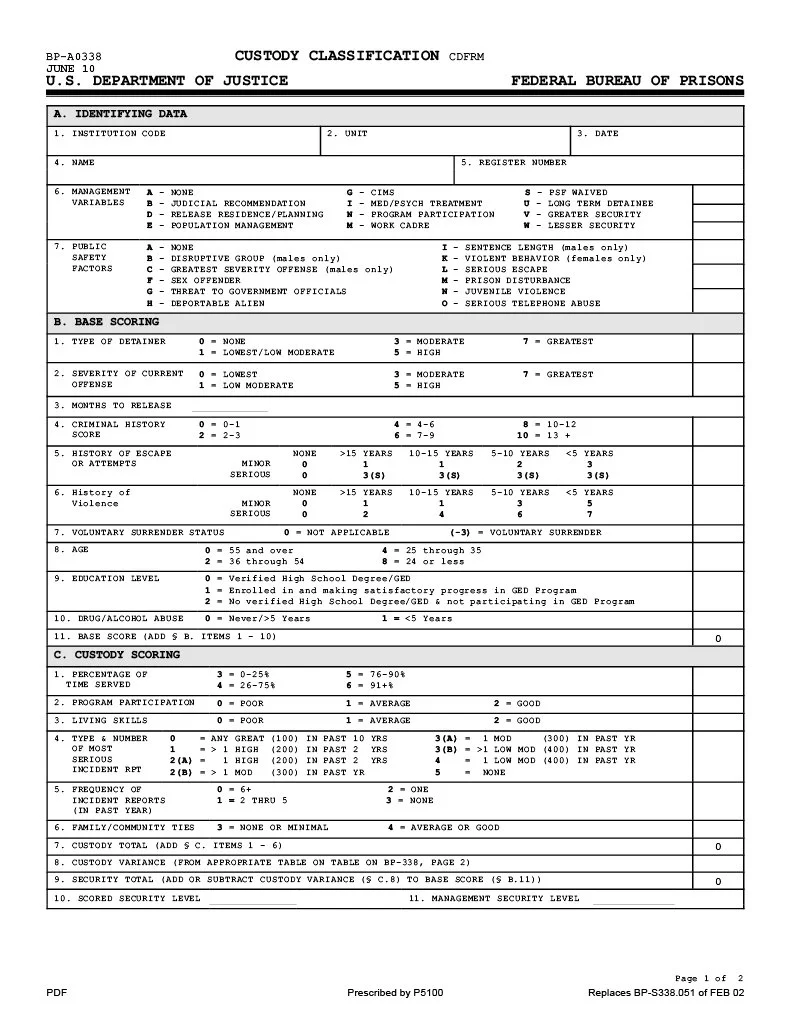
How Points Are Scored from the PSR. The BOP calculates these points using nine specific categories.
1. Severity of Current Offense:
Based on the narrative of the crime in the PSR, not just the charge.
Lowest (0 pts): Small-scale drug possession, simple white-collar theft.
Low Moderate (1 pt): Counterfeiting, minor fraud.
Moderate (3 pts): Drug trafficking (standard amounts), standard burglary.
High (5 pts): Armed robbery, large-scale drug distribution.
Greatest (7 pts): Homicide, kidnapping, treason.
2. Criminal History Score:
Matches the points listed in the sentencing section of your PSR.
0–1 Category Points: 0 pts
2–3 Category Points: 2 pts
4–6 Category Points: 4 pts
7–9 Category Points: 6 pts
10–12 Category Points: 8 pts
13+ Category Points: 10 pts
3. Age at Sentencing:
Younger people are statistically considered higher risk and receive more points.
Under 25: 8 pts
25–35: 4 pts
36–54: 2 pts
55 and Older: 0 pts
4. History of Violence:
Points depend on how recent and how serious the violence was.
None: 0 pts
Minor Violence (>15 years ago): 1 pt
Serious Violence (<5 years ago): 7 pts
5. Education Level:
HS Graduate or GED: 0 pts
No High School Degree/GED: 2 pts (This can also be a mandatory requirement for GED programming).
6. Voluntary Surrender:
If the judge allows you to self-report to prison (rather than being taken into custody immediately), the BOP subtracts 3 points from your total.
7. Drug/Alcohol Abuse:
Documentation of a substance use problem within the last 5 years adds 1 point. Note that while this adds a point, it is often necessary to qualify for the RDAP sentence reduction program.
The Bureau of Prisons (BOP) determines the Severity of Current Offense by comparing the narrative of the crime in the Presentence Report (PSR) against an official "Offense Severity Scale".
Crucially, the BOP scores the actual conduct described in the report, not just the specific statute you were convicted of.
How the Score is Calculated:
The BOP assigns a point value (0–7) based on the "most severe documented behavior" in the PSR:
Conduct Over Conviction: If you pled down from a violent charge to a non-violent one, but the PSI narrative still describes the violence in detail, the BOP will likely score the offense at the higher "violent" level.
Highest Rated Charge: For cases with multiple counts, the BOP uses the single most severe offense to determine the score.
Specific Severity Tiers:
Greatest (7 pts): Homicide, kidnapping, or armed robbery.
High (5 pts): Large-scale drug distribution or robbery.
Moderate (3 pts): Standard drug trafficking or burglary.
Low Moderate (1 pt): Minor fraud or property offenses between $2,000 and $250,000.
Lowest (0 pts): Personal drug use or property crimes under $2,000.
Key Factors in the Offense Narrative:
Weapon Enhancement: Using or possessing a firearm during the crime significantly increases the severity level.
Amount of Loss: For fraud and theft, the score scales with the dollar amount (e.g., property offenses over $250,000 are High Severity).
Drug Quantities: The BOP uses a "Marijuana Equivalent Chart" to standardize the severity of different drug types based on weight.
Role in the Offense: Being an organizer or leader can lead to a more severe rating than being a "minimal participant".

The judge uses the PSR to set the boundaries for the sentence:
Calculating Guidelines: The report identifies the applicable sentencing guidelines by calculating an "offense level" and a "criminal history category". This produces an advisory sentencing range (e.g., 24–30 months) that the judge must consider.
Identifying Statutory Limits: It lists the maximum and minimum penalties allowed by law for the specific crimes, which override guidelines if there is a conflict.
Plea Agreement Evaluation: If there is a plea deal, the judge uses the PSI to see how that agreement affects the potential sentence compared to if the defendant had been convicted on all original counts.
2. Applying the "3553(a)" Factors
In federal court, judges are required by 18 U.S.C. 3553(a) to consider specific factors, most of which are documented in the PSR:
Nature of the Offense: The report provides a narrative of the crime, including the defendant’s specific role, any violence involved, and the number of victims.
History and Characteristics: Judges review the defendant's upbringing, mental and physical health, employment history, and family ties to assess their character.
Victim Impact: The report includes statements from victims detailing financial, physical, or emotional harm, which helps the judge determine appropriate restitution.
3. Exercising Judicial Discretion
While the guidelines provide a starting point, the judge uses the PSR to decide whether to go higher or lower:
Mitigating Factors: Information such as a history of childhood trauma, successful drug rehabilitation, or strong community support can lead the judge to issue a "downward departure" or a more lenient sentence.
Aggravating Factors: Evidence of uncharged criminal conduct or a pattern of recidivism can justify a sentence at the high end of the range.
Rehabilitation Potential: The judge assesses whether the defendant is a good candidate for probation or specialized programs (like drug treatment) based on the probation officer's evaluation.
4. Resolving Disputes
At the sentencing hearing, the judge must formally rule on any objections raised by the defense or prosecution regarding facts in the PSI. If the judge finds a challenge has merit, they will order the report to be corrected; if they decide not to rely on a disputed fact, they must state that on the record.
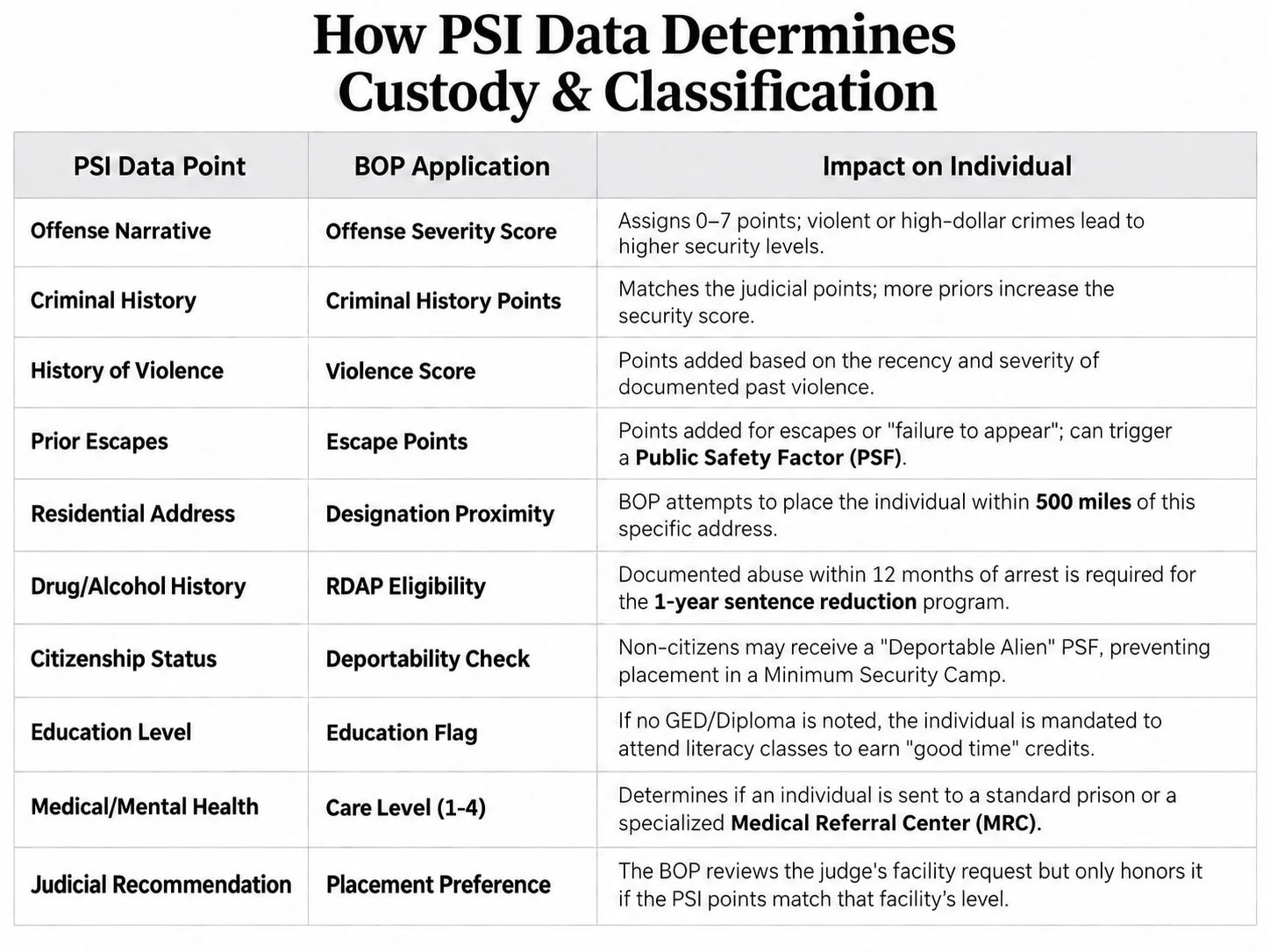
The Bureau of Prisons (BOP) uses the Presentence Report (PSR) as its primary source of data for almost every decision regarding an inmate's life in prison. While judges use it for sentencing, the BOP’s Designation and Sentence Computation Center (DSCC) uses it to "score out" an inmate for their initial placement and future programming.
1. Custody Classification and Security Level
The BOP enters data from the PSR into its SENTRY database to generate a security score, which dictates the security level of the facility (Minimum, Low, Medium, or High).
Scoring Primary Factors: Points are assigned based on details in the PSR, including the Severity of the Offense (documented behavior, not just the charge), Criminal History Category, History of Violence, and Escape History.
Static Risk Factors: The BOP assigns points for age (younger inmates score higher) and education level.
Public Safety Factors (PSFs): Certain facts in the PSR, such as a history of sex offenses or a pending detainer, can trigger a "PSF" that overrides the numerical score and requires a more secure facility.
Management Variables: Staff may use PSI data to justify placing an inmate in a facility different from their scored level due to unique needs like "Separation" (keeping co-defendants apart) or medical care.
2. Physical Location (Designation)
The PSI is the primary tool used to determine where an inmate is physically sent.
Proximity to Release Area: By law, the BOP must attempt to place inmates within 500 driving miles of their primary residence, which the BOP identifies via the address listed in the PSI.
Judicial Recommendations: While not binding, the BOP reviews the "Judicial Recommendation" section of the PSI. They will honor a specific facility request only if the inmate's security score and programming needs match that facility.
3. Determining Programming Needs
Once designated, the Unit Management Team (case managers and counselors) uses the PSI to identify specific "criminogenic needs" that the inmate must address to red]
The PATTERN Tool: Under the First Step Act, the BOP uses PSI data to feed the Pattern Assessment Tool, which determines an inmate’s recidivism risk and eligibility for earned time credits.
Substance Abuse (RDAP): Documentation of substance abuse within the 12 months prior to arrest in the PSI is often the only way an inmate can qualify for the Residential Drug Abuse Program (RDAP), which can reduce a sentence by up to 12 months.
Medical and Mental Health Care Levels: The PSI’s medical and psychological history sections determine an inmate's Care Level (1–4). An inmate with severe issues documented in the PSI will be sent to a Medical Referral Center (MRC) or a facility with specialized psychological resources.
Educational and Vocational Needs: If the PSI notes a lack of a high school diploma or GED, the inmate is automatically flagged for mandatory literacy programs.