


Sentence Reduction Guide: Maximizing Early Release.
This guide breaks down Good Time Credit, the First Step Act (FSA), the Residential Drug Abuse Program (RDAP), and the Second Chance Act (SCA).
What is the First Step Act (FSA)?
The First Step Act (FSA) is a bipartisan criminal justice reform law signed in December 2018 by President Donald J. Trump . It’s goal is to reduce recidivism and the overall population of the FBOP. It represents rehabilitation and fairness. The FSA also focuses on sentencing reforms and improving the conditions inside prison.
The FSA enacted several critical reforms to Bureau of Prisons (BOP) policies:
Good Conduct Time (GCT): Increased from 47 to 54 days per year of the imposed sentence. Recidivism Reduction: Directs the BOP to use a risk and needs assessment system (PATTERN) to classify risk levels and assign evidence-based programs such as vocational training, education, and behavioral therapy. Sentencing Retroactivity: Makes the Fair Sentencing Act of 2010 retroactive, allowing those convicted of crack cocaine offenses before 2010 to petition for sentence reductions. Mandatory Minimums: Reduces certain mandatory minimums and expands the "safety valve" that allows judges to bypass minimums for some non-violent drug offenders. Stacking Fix: Clarifies that enhanced penalties for using a firearm during a crime only apply if the offender has a prior final conviction for a similar offense. Proximity to Home: Requires the BOP to house within 500 driving miles of their primary residence whenever practicable. Humane Treatment: Prohibits the shackling of pregnant women and restricts the use of juvenile solitary confinement. Essential Products: Mandates the free provision of feminine hygiene products to incarcerated women.

There are distinct programs that operate side-by-side to reduce the time you have to spend in secure custody. Good Conduct Time (GCT) Incentivize following prison rules and avoiding discipline. How it’s earned, by displaying exemplary compliance with institutional regulations. Maximum Rate: Up to 54 days per year of the imposed sentence. Application. Directly reduces the length of the overall sentence. Eligibility: Available to almost all individuals serving more than one year.
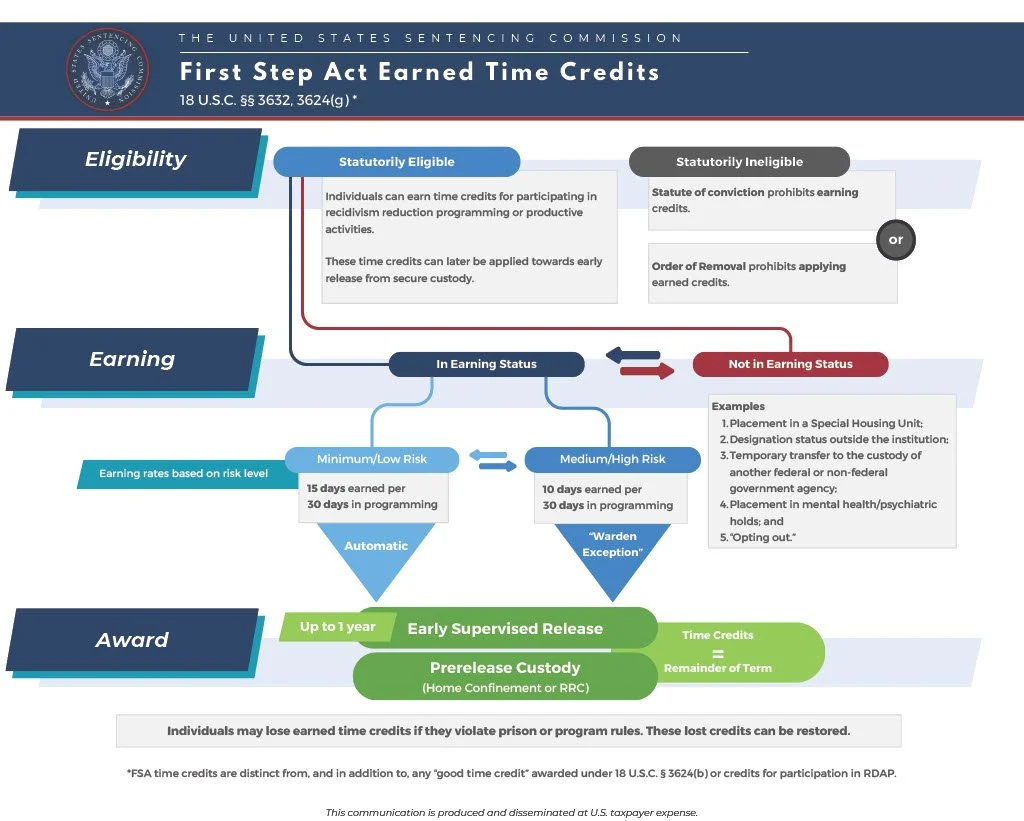
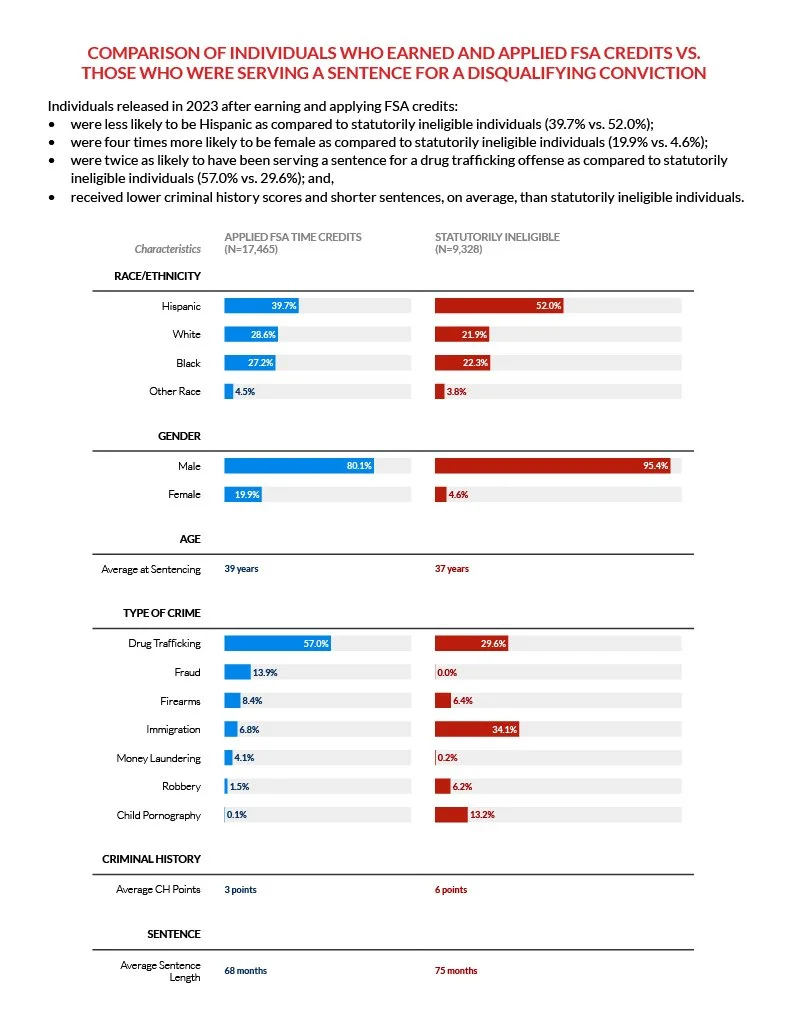
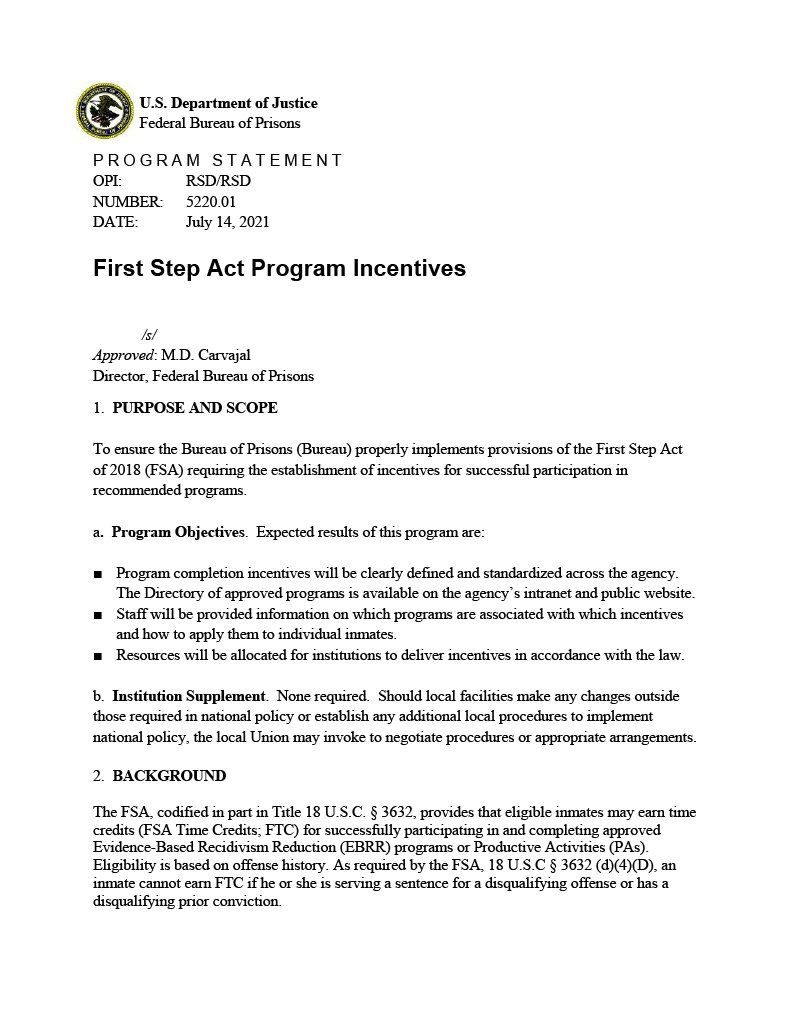
FSA Earned Time Credits (ETC). Incentivize participation in recidivism-reduction programs. How It's Earned: Successful participation in Evidence-Based Recidivism Reduction (EBRR) programs or Productive Activities. Maximum Rate: 10 to 15 days for every 30 days of successful program participation. Applied toward prerelease custody (halfway house/home confinement) or early supervised release. Restricted based on the conviction; a long list of specific offenses (e.g., violent, terrorism, sex offenses) makes an individual ineligible.
Think of FSA Earned Time Credits as a two-tank system. Every 30 days spent in approved programs earns 10 or 15 days of credit, and the law dictates exactly where those credits flow.
Tank 1: The "Early Release" Tank. Purpose: These credits literally shorten your sentence by moving your "Full Term Release Date" forward.
Capacity: This tank maxes out at exactly 365 days (12 months).
Transition: Once you hit 365 days, this tank is full, and any new credits you earn must go to the second tank.
Tank 2: The "Prerelease Bucket". Purpose: These credits do not shorten your sentence further, but they buy you time out of a prison cell. They are used to move you to a Halfway House (RRC) or Home Confinement earlier than standard allowances. Capacity: Unlimited. There is no cap on how many days you can put in this bucket.

Additional FSA Incentives. Beyond time credits, the FSA offers other incentives to encourage continued participation: Free Phones: 300 free phone minutes per month.
Nearer Release Transfers: Priority consideration for transfers to facilities closer to the individual's release destination.
Financial Awards: Monetary achievement awards for completing 100+ hours of EBRR programming.
The PATTERN Risk Assessment. The PATTERN tool evaluates recidivism risk and determines how many FSA credits can be earned per month. How Earning Rates Work. Standard Rate: Earn 10 days of credit for every 30-day period of successful participation. Bonus Rate: Minimum or low-risk, can earn an additional 5 days (totaling 15 days) for every 30-day period if they maintain their low or minimum risk status over two consecutive assessments.
When and How Data is Collected. Initial Timing: Within the first 28 to 30 days of arrival at a facility, an inmate receives an initial risk and needs assessment using the PATTERN. Reassessments:** Assessments are typically conducted every 180 days (approximately every 6 months) during routine program reviews. Assessment Factors: The tool evaluates static factors (like age at the time of the offense and criminal history points) and dynamic factors (like education level, disciplinary record, and work assignments). Data Sources: Data is collected from the Presentence Investigation Report (PSR), staff interviews, and self-reported surveys.

The SPARC-13 Surveys: To achieve "Opt-In" status, complete the surveys on the TRULINCS computer system. These cover 13 specific "criminogenic needs" and total roughly 100 questions. Key surveys include: Measures of Criminal Attitudes and Associates (MCAA): Assesses "Antisocial Peers" and "Cognitions" Brief Anger-Aggression Questionnaire (BAAQ):* Assesses the Anger/Hostility need area. Adverse Childhood Experiences (ACEs) Scale:* Assesses the Trauma domain.
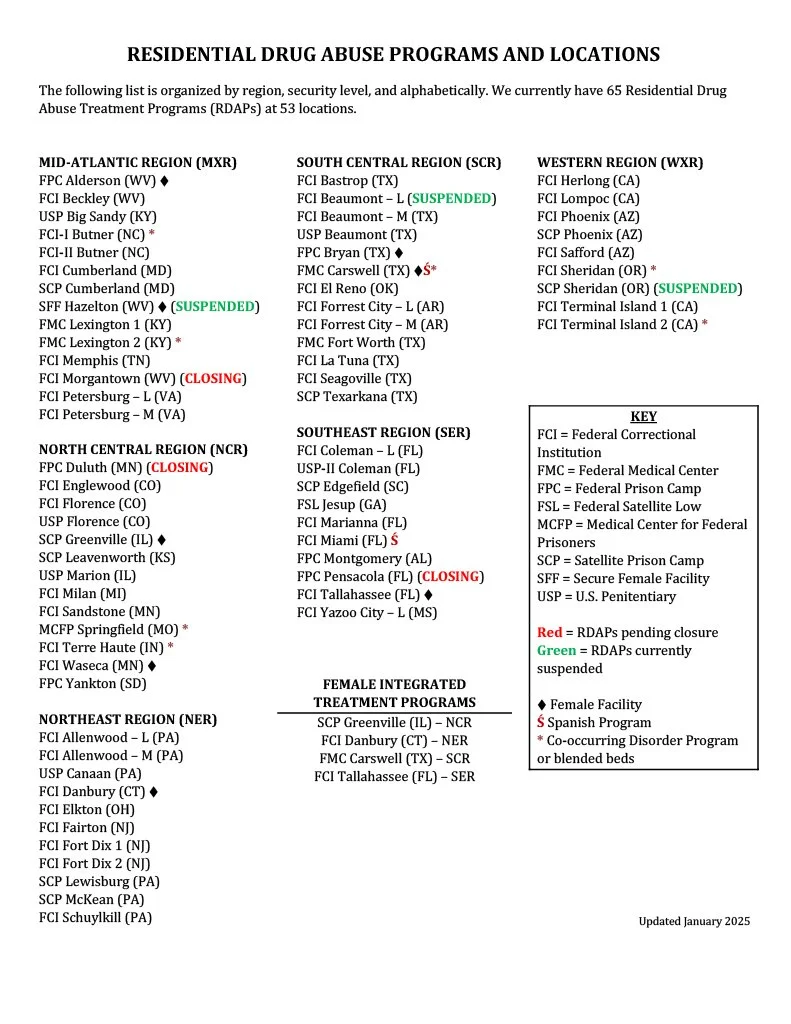
Residential Drug Abuse Program (RDAP). The Residential Drug Abuse Program (RDAP) is the BOP's most intensive 500-hour substance abuse treatment program. Sentence Reduction: Successfully completing this program provides a sentence reduction of up to 12 months for sentences longer than 36 months. Sentence Length Minimums: You must be sentenced to at least 37 months to be eligible for the full one-year reduction]. Sentences of 31–36 months are capped at 9 months; sentences of 30 months or less are capped at 6 months. Disqualifiers: Only "non-violent" offenders are eligible for the sentence reduction. Current offenses involving weapons, physical force, or prior convictions for violent crimes (like robbery or aggravated assault) are disqualified from the early release benefit.

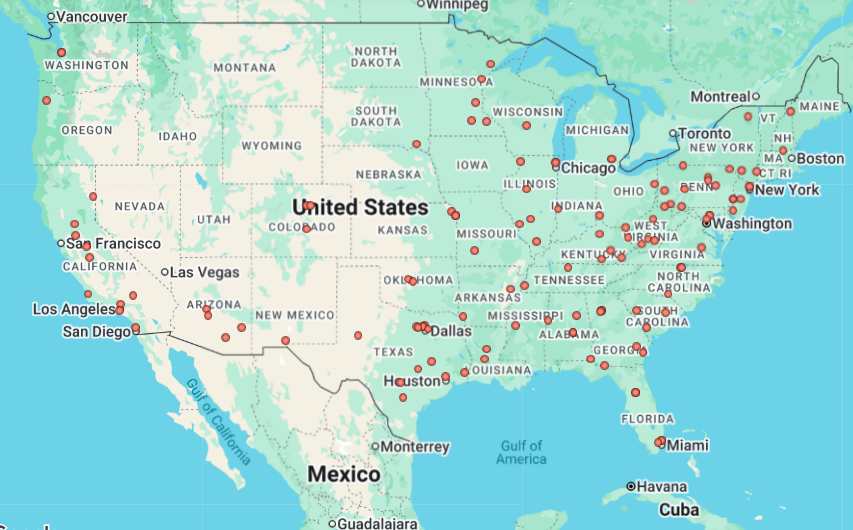
Federal Prisons
The Second Chance Act (SCA) & Community Transition. Under the Second Chance Act (SCA), the BOP is authorized to place people in community-based facilities to help them adjust to society. Unlike FSA credits—which are earned "rewards"—SCA placement is a discretionary program based on an inmate's specific reentry needs.
Halfway House (RRC): Can be placed in a Residential Reentry Center for up to 12 months before their projected release date. Home Confinement: A portion of the pre-release time can be served at a residence, legally limited to the shorter of 10% of the total sentence or 6 months. Individualized Review: The BOP must evaluate every inmate individually using five statutory factors:
1. Resources of the facility contemplated.
2. Nature and circumstances of the offense.
3. History and characteristics of the American with a federal conviction.
4. Statements by the sentencing court.
5. Pertinent policy statements issued by the Sentencing Commission.
Strategy: The Power of "Stacking". The most significant change in federal sentencing strategy is that FSA credits are now cumulative and stackable with the Second Chance Act (SCA). By maximizing Good Conduct Time, completing RDAP (if eligible), and applying FSA Earned Time Credits, you can drastically reduce a sentence.